 Jeetech Studio
Nonogram Puzzles: How They Work and How to Solve Them
Jeetech Studio · 2026-11-03
What are nonogram puzzles?
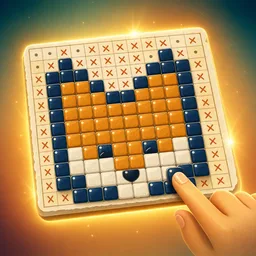
Nonogram puzzles are picture-logic games played on a grid. Numbers sit beside each row and above each column. Those numbers tell you which cells to fill in. When you've filled the right ones, a hidden picture appears.
You may know them as picross, griddlers or paint-by-numbers logic. The names differ, but the idea is the same. Every picture can be solved by reasoning alone, so you never need to guess.
How to read the clues
A clue is a number, or a series of numbers, that describes runs of filled cells in that line.
- A single number like 4 means there is one run of four filled cells in a row.
- Several numbers like 2 1 3 mean three separate runs, in that order, of 2, 1 and 3 cells.
- Runs must be separated by at least one empty cell.
On a 10-cell row, the clue "2 1 3" needs 2 + 1 + 3 = 6 filled cells plus at least 2 gaps. That's 8 cells, leaving 2 spare. That spare space is where the solving begins.
Colour nonograms
Some nonograms use several colours. The clues are coloured too, and each run must match its shade. There's one extra wrinkle: two runs of different colours can sit side by side without a gap. Two runs of the same colour still need an empty cell between them.
Practical tips for solving
Start with the biggest clues
A line whose clues almost fill it is the easiest place to begin. If a 10-cell row has the clue 8, the run can only slide two cells either way. That means the middle six cells are definitely filled, whichever way it slides. This "overlap" trick is the foundation of most solving.
Fill and finish full lines
If the clues plus the minimum gaps add up to exactly the line's length, you can fill the whole line immediately. A clue of 0, or an empty line, tells you every cell is blank.
Mark empty cells, not just filled ones
Marking cells you know are empty is as important as filling the others. An X or a dot stops you from re-checking the same cell and shows where a run can't reach. Use it freely.
Work from the edges
If a row's first cell is filled and the first clue is 3, the run must cover the first three cells. The fourth is then empty. Edges often give you free progress.
Cross-check rows and columns
Every cell belongs to one row and one column. When you learn something in a row, scan the columns it touches. A single new cell can unlock a clue elsewhere. Bounce between the two directions instead of finishing one line at a time.
Don't guess
If you're stuck, look for a different line rather than gambling on a cell. A wrong guess can cascade into a messy grid that is hard to untangle. If a line won't give way, leave it and come back after other lines have changed.
Check your work as you go
Count the filled cells in a line against its clues now and then. A slip early in a puzzle often only shows up near the end.
Common beginner mistakes
- Forgetting that runs need a gap between them (in single-colour puzzles).
- Reading clues out of order. Clues run left to right, or top to bottom.
- Skipping the empty-cell marks, then losing track of what's been ruled out.
- Starting with the smallest clues instead of the most constrained lines.
Where Nonogram Puzzles: Color Logic fits
If you'd like to practise on your phone, Nonogram Puzzles: Color Logic (the in-game name is Nonogram Atelier) is a calm take on the genre. Here's what the store listing says it offers:
- 120 handcrafted levels across 10 themed islands, from small starter grids to big, detailed finales. Every level is open from the start, so you can jump to whatever you feel like solving.
- Colour puzzles, where some levels use a palette and the clues are coloured to match.
- Simple controls: tap a cell to fill it, or drag along a row or column to paint a whole run. An X or dot tool marks cells you know are empty, and you can undo or restart whenever you like.
- Hint Brushes for stubborn lines. You get 3 free each day, and can get more with Pigments or by choosing to watch a rewarded ad.
- A Gallery and atelier: finished pictures are framed in your Gallery, and you spend Pigments, the coins earned by solving, to restore the rooms of your atelier.
- A daily puzzle with a forgiving streak, star ratings, a freeze boost to protect your streak, and a colourblind mode.
- Offline play, with no account or login. Progress is stored on your device. Sound and haptics can be switched off.
On ads: the listing says there are no banners in the early levels, and the first interstitial comes only after level 10. After that, ads appear at most once every four levels. Rewarded ads only play when you choose them. A one-time Remove Ads purchase is available, as are optional coin packs at fixed prices.
FAQ
Do I need to guess in nonogram puzzles?
No. A well-made nonogram can be solved with logic alone. If you feel you must guess, look for another line first, or use a hint if the game offers one.
Are nonograms good for beginners?
Yes, as long as you start with small grids. Small puzzles teach the overlap and edge techniques quickly, and you can move to larger pictures as you get comfortable.
Can I play nonogram puzzles offline?
It depends on the app. Nonogram Puzzles: Color Logic works fully offline, according to its store listing, so it suits flights and commutes.
Ready to reveal your first picture? Try Nonogram Puzzles: Color Logic on Google Play.